Nature is our most important source of inspiration and experience—while also being a shared responsibility. As outdoor and sportswear brands, Maier Sports and Gonso are committed to systematically assessing their environmental impacts and creating a basis for reducing them. A key component in this process is the systematic analysis of our greenhouse gas emissions.
In the 2024/25 financial year, a Corporate Carbon Footprint (CCF) was calculated for Maier Sports GmbH for the second time, with external support from ClimatePartner. The calculation was conducted in accordance with the internationally recognised Greenhouse Gas Protocol (GHG Protocol), the globally established standard for recording and assessing greenhouse gas emissions at corporate level. All relevant emission sources within the defined system boundaries were taken into account. By repeating the assessment, comparability over time is ensured and a robust data basis is created for the further development of our climate management.
What is a carbon footprint?
The carbon footprint is documented through a corresponding assessment that shows the total amount of carbon dioxide emissions generated by a company. These emissions arise over a defined period through the company’s direct and indirect activities as well as across all stages of the product life cycle. The term “emissions” refers to the release of carbon dioxide (CO₂) and other greenhouse gases into the atmosphere. These emissions should be reduced, as they contribute to climate change.
Overview over our Emissions
Emissions of our brands Maier Sports and Gonso
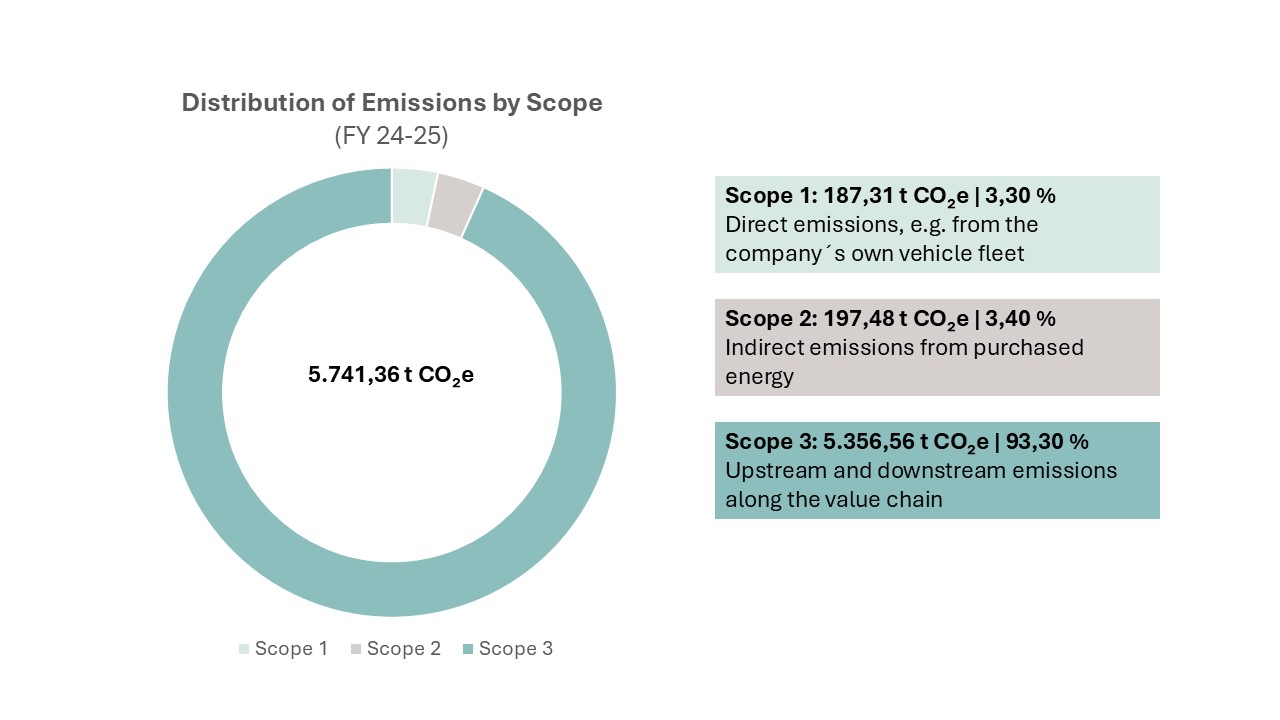
To obtain as clear a picture as possible of our climate impact, we systematically record our greenhouse gas emissions across all relevant areas of the company. The Corporate Carbon Footprint illustrates how emissions are distributed along our business activities and where the key emission sources are located. In the 2024/25 financial year, the total greenhouse gas emissions of Maier Sports GmbH amounted to 5,741.36 tonnes of CO₂ equivalents. The presentation shows how these emissions are allocated across the three so‑called scopes.
As is typical for the textile and apparel industry, the majority of emissions occur in Scope 3—for example in relation to materials, transportation, and other processes outside the company’s direct operations. Transparently presenting these relationships is an important step for us in better understanding emission drivers and enabling the traceability of developments over time.
Transparency as a foundation
The repeated assessment of our Corporate Carbon Footprint represents an important step for Maier Sports and Gonso in better understanding our climate impact and establishing a sound basis for further actions. On this basis, we gain valuable insights into key emission hotspots along our business activities. At present, our focus is on further strengthening the data basis and awaiting the results of the next assessment. Based on this, we will evaluate which next steps are appropriate and effective. In doing so, clear, honest, and understandable communication is particularly important to us. We transparently show where we currently stand.
Challenges in calculating the carbon footprint
The greatest challenge in calculating the carbon footprint for us is the availability and quality of data. Data collection places new requirements on the various departments within the company, for which we have sought and identified tailored solutions. During the data collection process, we already identified the largest data gaps and, at the same time, laid the groundwork to ensure that the next assessment will be simpler, faster, and more efficient.
Why do we not provide a comparison between the first and second assessment periods?
Several changes were made to the underlying data, which means that a comparison between the two assessment periods is not possible. Following the first assessment period (calendar year 2023), the reporting period was changed from the calendar year to the financial year. This change is due to upcoming reporting requirements under the Corporate Sustainability Reporting Directive (CSRD), which considers all key figures on a financial‑year basis. Accordingly, the second data collection relates to the 2024/25 financial year.
In addition, the scope of the assessment was expanded. In the first assessment, only emissions from operations were considered, such as energy consumption in buildings, business travel, the vehicle fleet, as well as upstream and downstream transportation. In the second assessment, we also began to account for our products and their impact on the emissions calculation. This area accounts for the largest share of emissions.